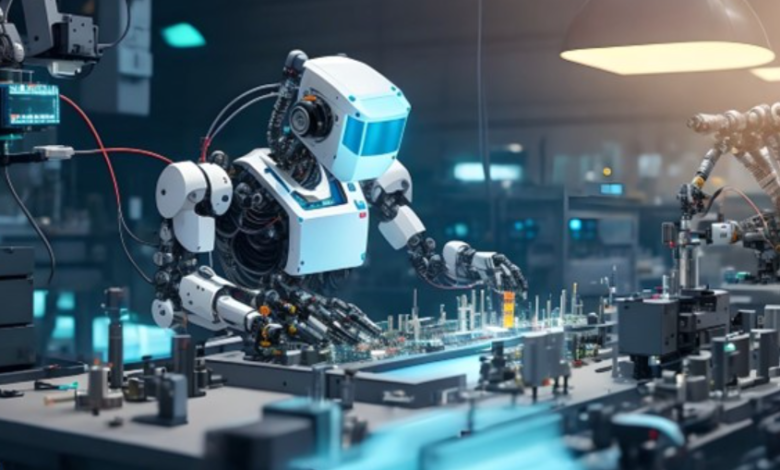
Plant automation continues to evolve as food and beverage producers look for greater efficiencies to improve throughput and reduce costs. In 2026, expect F&B operations to invest even more heavily in plant automation. About 80% of manufacturing executives say they expect to earmark at least 20% of their improvement budgets for smart manufacturing tools, such as sensors, automation hardware, advanced systems controls, and data analytics, to gain a competitive edge.
How are they planning to spend their money? Let’s look at some of the biggest food and beverage engineering trends for 2026.
Smart Manufacturing Becomes a Foundational Component
We’ve been talking about Industry 4.0 for years. and there have been dozens of pilot projects, tests, and small upgrades along the way. In 2026, smart manufacturing is officially moving into core operational strategy. Instead of testing isolated digital tools on a single line, companies are organizing plant automation roadmaps around complete visibility across the production workflow.
Food and beverage engineering teams are prioritizing foundational layers such as:
- Sensor networks for batch, flow, temperature, pressure, and quality verification
- Cloud-ready SCADA systems with historian and analytics integration
- Data models that reveal relationships between downtime events, operator influence, and equipment conditions
- Upgraded automation hardware that can support long-term digital workflows
These investments create the infrastructure needed for AI-driven analysis, predictive maintenance, and automated decision support.
Cybersecurity Moves to the Forefront of Plant Automation Planning
As equipment, sensors, vision systems, IIoT devices, and dashboards become interconnected, the cybersecurity risk surface expands. Cyber-attacks targeting food and agriculture operations have continued to rise over the past two years, and compliance pressure will intensify when CISA’s 72-Hour reporting mandate, under the Cyber Incident Reporting for Critical Infrastructure Act (CIRCIA), is expected to be finalized in mid-2026.
For food and beverage engineering teams, cybersecurity is no longer an IT responsibility alone. Automated processes, control panels, PLC networks, and SCADA systems all require engineered safeguards, including segmentation strategies, access control design, vendor remote-access restrictions, and secure patching workflows.
Common threats targeting automated food plants include:
- Ransomware aimed at production networks
- Unauthorized remote-access/third-party connections
- Misconfigured smart sensors
- Control panels connected without proper segmentation
Engineering leaders must now consider firewall placement, encryption protocols, role-based access, and network resilience as part of every automation upgrade or system expansion.
Data Integration Determines Whether Automation Projects Deliver ROI
Many F&B operations have a mix of older, legacy equipment that may or may not be natively integrated. It’s not uncommon for operations to install advanced systems that leverage vision inspection, batching software, processing controls, and packaging automation, only to discover the tools cannot share data seamlessly. This limits visibility and significantly reduces the value of food automation.
Industry analysts point to disconnected systems and insufficient data integration as a major reason why many installations fail to deliver the expected ROI. Here’s how this commonly plays out.
| Integration Weakness | Impact on Operations | Typical Root Cause |
| Batch and packaging systems operate independently | Inconsistent flow, bottlenecks, and quality variation | No shared recipe or sequencing logic |
| SCADA without historian data | Limited trend analysis and weak downtime insights | Missing data infrastructure |
| Machine-specific analytics only | No plant-level understanding of performance | Siloed OEM-provided tools |
| Unsynchronized timestamps | Difficult root-cause analysis and inaccurate reports | Inconsistent controller or network configuration |
Food and beverage engineering professionals must architect systems where PLCs, HMIs, SCADA, historians, MES, and cloud platforms operate as a cohesive ecosystem and not just as isolated systems that are controlled centrally.
See also: The Role of Tech Platforms in Driving the Next Digital Wave
Automation Architecture Shifts Toward High-Reliability, High-Scalability Design
As plants compress production schedules and run close to capacity, downtime tolerance approaches zero. This has created an increased focus on:
- Redundant networks and failover strategies
- Control panels designed for expansion instead of short-term functionality
- Standardized PLC/HMI architecture across entire facilities
- Equipment synchronization that minimizes micro-stops and speed loss
- Machine safety to protect workers and equipment
These shifts are critical to support expansion, add additional SKUs, handle more frequent changeover or complex packaging requirements, and meet operational efficiency benchmarks. With today’s complex, interconnected production lines, reliability and redundancy is more important than ever.
You Need Robust Food and Beverage Engineering
In 2026, plant automation success relies on robust food and beverage engineering to design, integrate, and support the technology it controls.
Pacific Blue Engineering is a team of food and beverage engineering experts providing custom automation solutions, legacy control modernization, and functional safety services for the most demanding environments. Learn more about how we can help by visiting the Pacific Blue Engineering website or requesting a consultation.