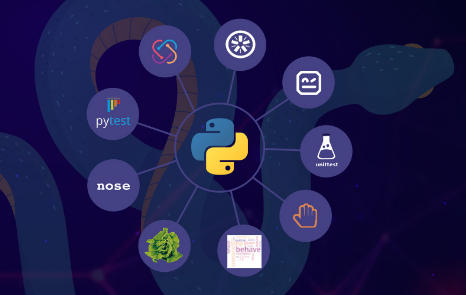
The continuous advancement of software systems has established Python frameworks as an essential enabler of scalable, modular, and automated verification procedures. These frameworks operate effectively to support unit, integration, and system testing phases and leverage reusable components and adaptable orchestration techniques.
Python’s compatibility with CI/CD systems, plugin frameworks, and distributed testing setups renders it a reliable option for extensive software validation. In this context, tools like Pytest and Robot Framework have become essential for attaining accuracy-focused and consistent testing processes, especially when applied to integration testing areas.
Evolution of Python Testing Frameworks
Python testing frameworks have undergone progressive transformation, shifting from minimal unit verification tools to advanced orchestration systems capable of supporting hybrid validation layers. The evolution emphasizes modular test structure, data-driven input management, and cross-environment consistency.
Modern frameworks execute predefined scripts and incorporate fixture management, runtime dependency injection, and environment-aware configurations. This progression has made testing frameworks in Python essential components of continuous quality pipelines, particularly in automated regression and integration validation scenarios.
Pytest and Robot Framework represent two primary pillars of Python’s testing ecosystem. Both frameworks offer methods to ensure uniform verification logic throughout the functional, regression, and integration phases. Their adoption has grown alongside cloud-based pipelines and containerized environments, supporting concurrent execution and improved test tracking.
Pytest: Modular and Data-Driven Testing
Pytest is highly recognized for its flexibility and organized method in test creation. The framework facilitates clear organization of test functions, scalable fixture configurations, and parameterized execution. Its system of plugins makes it easy to connect with tools that help with checking code coverage and running tests at the same time.
Core Components and Workflow
Pytest’s architecture revolves around fixture management, parameterization, and reporting. Fixtures act as reusable configuration providers that abstract environment setup, dependencies, and teardown processes. This modularity reduces redundancy and strengthens test isolation.
Parameterized testing allows developers to assess various input combinations with a single validation function, improving test coverage while minimizing code duplication. Moreover, Pytest offers assertion introspection, facilitating the production of detailed output that eases the debugging process during failures.
Its connection with continuous integration platforms like Jenkins, GitHub Actions, and GitLab CI guarantees that automated validation stays in sync with rapid development cycles. The integration actively promotes ongoing feedback cycles, allowing teams to identify and address regressions during the initial phases of code distribution.
Extensibility through Plugins
Developers can enhance Pytest using the numerous plugins available in its ecosystem. Examples include pytest-xdist, enabling parallel test execution; pytest-cov, measuring code coverage; and pytest-django or pytest-flask, offering framework-specific validation. As a result of these plugins, it is possible for Pytest to become a complete validation framework from microservices to massively scaled distributed systems.
Furthermore, Pytest enables direct engagement with APIs and databases via fixture-based resource injection. This enables developers to replicate end-to-end testing without switching between frameworks, in line with the goals of integration testing processes.
Robot Framework: Keyword-Driven Automation
Robot Framework is a universal automation framework derived from keyword-driven methodology. Unlike Pytest’s function-based structure, Robot Framework brings greater clarity and reusability via human-friendly keywords representing actions and validations. The use of this structure connects test design and execution without requiring complex script elements.
Structure and Design
Tests in Robot Framework are organized into suites, defined in structured files like .robot or .resource. A test case is an independently executable unit consisting of keywords that specify particular actions and follow a defined execution sequence, including setup, execution, and teardown. These keywords can be user-defined or sourced from libraries such as SeleniumLibrary, DatabaseLibrary, or RequestsLibrary, depending on the testing context.
This abstraction streamlines cross-domain testing, enabling the same syntax to verify APIs, GUIs, and backend systems. Test data and settings can be saved independently, allowing strong data-driven verification across various environments.
Integration with Python Libraries
One of the defining characteristics of Robot Framework is its deep integration with Python libraries. Custom libraries can be developed in Python and directly imported into Robot test suites. Such integration ensures compatibility with existing Python-based validation assets, promoting reusability and reducing maintenance complexity.
Robot Framework also supports remote execution and distributed test orchestration. Robot tests can run across virtualized and containerized environments using remote library interfaces and CI hooks, making them suitable for hybrid infrastructure.
Integration Testing with Python Frameworks
Integration testing verifies that multiple independent components interact correctly, exchanging data and functioning at interfaces as designed. Environmental inconsistencies affect integration tests. Python frameworks address these challenges through configuration files, environment variables, and plugin-based runtime controls.
Pytest’s conftest.py and Robot Framework’s variable files ensure environmental uniformity across distributed nodes. Integration with CI/CD pipelines further enhances automation efficiency. In Python frameworks like Pytest and Robot Framework, integration testing is a combination of the layers of test logic with configuration, API, database, or microservices.
Workflow Design
Integration testing workflows in Python are typically structured to ensure minimal environmental dependency and maximal reproducibility. They follow a layered configuration model:
- Setup Layer: Establishes the system state, including API endpoints, service containers, and mock databases.
- Execution Layer: Executes the interaction sequences between connected modules, validating communication protocols and data synchronization.
- Verification Layer: Applies assertions to evaluate interface integrity, schema conformity, and data flow consistency.
Environment Consistency and CI Integration
Integration tests are sensitive to differences in the environment. Python frameworks address this through configuration files, environment variables, and plugin-based runtime controls. Pytest’s conftest.py and Robot Framework’s variable files ensure environmental uniformity across distributed nodes. Integration with CI/CD pipelines further enhances automation efficiency.
Developers link both frameworks to containerized infrastructures like Docker and orchestration systems like Kubernetes using configuration files such as .yaml or .ini. Such a configuration allows concurrent execution across environments, accelerating validation cycles while maintaining result traceability.
Continuous Validation in Scalable Environments
The rapid adoption of containerized infrastructures and distributed test grids necessitates scalable validation systems. Python testing frameworks fulfill this need by allowing test parallelization, container management, and on-demand environment setup. Pytest attains this functionality via pytest-xdist, allowing simultaneous execution across several CPU cores or nodes. Such parallelization significantly reduces test duration in large regression cycles.
The demand for scalable execution environments has rendered cloud-based validation platforms crucial. These systems enable simultaneous operation of numerous test instances across various browser or device setups, improving interoperability testing without requiring local resource management.
LambdaTest offers this kind of infrastructure, presenting a cohesive platform for running automated tests developed in Python frameworks such as Pytest and Robot Framework. Tests can be run concurrently on various operating systems, browser versions, and actual devices through its cloud-based grid.
It seamlessly integrates with CI/CD pipelines, as well as frameworks that adhere to the rules of Selenium WebDriver, allowing efficient performance of cross-browser testing. The platform provides instantaneous and log access, simultaneous execution functions, and scalable execution, which maximizes the amount of time saved in total execution time and offers a true feedback loop in integration testing processes.
Python Frameworks for Integration with Web Testing
The Python ecosystem supports integration testing with frontend validation layers through direct compatibility with Selenium-based implementations. Selenium WebDriver is a widely used tool for automating browser interactions. For those asking what is Selenium WebDriver, it is a tool that automates browser interactions, allowing scripts to control browsers, perform UI validations, and verify user interaction flows.
Pytest uses fixtures to integrate Selenium WebDriver, enabling developers to instantiate, control, and terminate web sessions within test cycles. This structure enables validation across DOM elements, CSS selectors, and asynchronous JavaScript events. The interaction model relies on driver objects that perform operations on browser instances, ensuring precise synchronization and control flow management.
Robot Framework extends this through SeleniumLibrary, enabling high-level keyword abstraction for browser operations such as navigation, form submission, and visual element verification. This abstraction simplifies UI validation, making it interoperable with other functional testing layers.
Such frameworks extend beyond traditional automation by enabling hybrid testing workflows that combine API, database, and UI validations within a unified execution cycle. This interoperability supports multi-tier architecture validation and accelerates defect localization during integration testing.
Comparative Analysis: Pytest vs. Robot Framework
Both Pytest and Robot Framework address overlapping validation domains but differ significantly in their architectural philosophies and operational designs.
Pytest:
- Emphasizes functional modularity and fixture reusability.
- Preferred for projects with extensive Python scripting and CI/CD integration.
- Provides extensive assertion customization and parameterized test capabilities.
- Offers seamless plugin integration for database, API, and UI testing.
Robot Framework:
- Built on a keyword-driven design for enhanced readability.
- Effective in mixed-technology environments and non-programmatic test definition.
- Integrates seamlessly with external libraries and remote execution services.
- Perfect for acceptance, comprehensive, and integration test automation.
In high-complexity environments, hybrid approaches often combine both frameworks. Pytest handles logic-intensive validations, while Robot Framework manages high-level orchestration and reporting. This combination provides a comprehensive validation layer suitable for continuous deployment pipelines.
Integration Testing Metrics and Traceability
Integration testing efficacy depends on quantifiable metrics, including interface coverage, execution time, failure localization, and data consistency validation. Python frameworks provide native mechanisms for metric generation and result aggregation.
Pytest supports coverage tracking through pytest-cov and failure analysis via structured report generation (pytest-html, allure-pytest). Robot Framework complements such instrumentation through robot logs, which aggregate results across distributed test suites, enabling traceability across layers.
Integrating these reporting modules with CI tools provides immediate visibility into test results, facilitating quick resolution of failures and improved traceability. Moreover, employing containerized execution environments guarantees uniformity in validation results between local and cloud settings.
Advancing Toward Intelligent Integration Testing
As software architectures grow increasingly complex, Python testing frameworks are evolving toward intelligent orchestration. New improvements encompass machine learning-driven failure forecasting, flexible test choice, and context-sensitive fixture optimization.
These features use data-informed insights from past executions to enhance upcoming validation cycles. Frameworks are enhanced with predictive analytics to detect high-risk elements, reducing redundant execution and improving test scheduling.
Integration testing in this framework is becoming more automated, focused on data, and scalable. Frameworks such as Pytest and Robot Framework are integrating AI-powered plugins that facilitate differential result tracking, anomaly detection, and automatic recovery functions.
Conclusion
Python testing frameworks have progressed to powerful adaptive validation systems across unit, functional, and integration stages. Pytest’s modular fixture design and Robot Framework’s keyword abstraction work together to create durable, maintainable, reliable, and scalable test architectures.
When integrated into CI/CD systems with associated resources in cloud infrastructures, the frameworks offer complete validation, rapid feedback, and reliability in distributed infrastructure.
The integration of Python frameworks with modern development processes marks a shift toward automation maturity and continuous integration testing. Automation maturity means continuously testing integration with an evolving architecture with performance benchmarks.