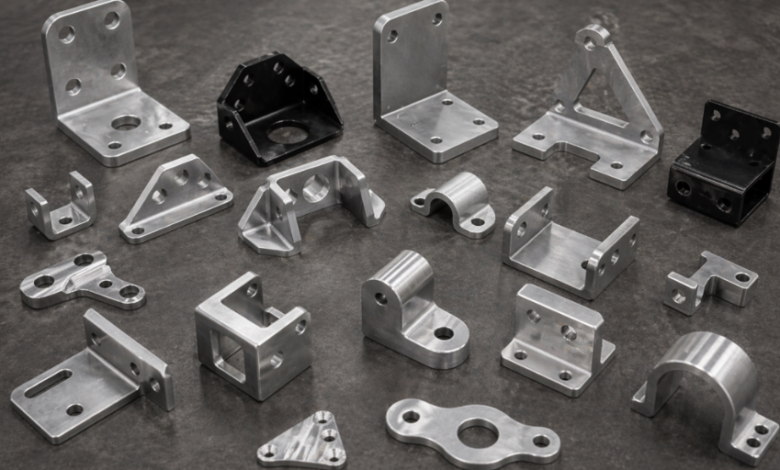
Designing a CNC machined aluminum bracket involves more than selecting a material and creating a drawing. Engineers must consider machining time, material waste, dimensional accuracy, assembly requirements, and long-term performance. While many brackets are produced from solid aluminum blocks, an extruded aluminum blank can provide a more efficient starting point for certain designs.
An extruded blank is a piece of aluminum shaped through an extrusion process before it reaches the CNC machining stage. Instead of removing most of the material from a solid block, manufacturers can begin with a profile that already resembles the finished component. This approach can reduce machining requirements, simplify production, and improve cost control.
Understanding the Role of an Extruded Blank
An aluminum extrusion is produced by pushing heated aluminum alloy through a shaped die. The resulting profile has a consistent cross-sectional shape and can be cut into individual blanks for further processing.
For a CNC machined bracket, the extrusion may include features such as ribs, channels, mounting surfaces, or basic structural walls. CNC machining then adds the precise holes, slots, pockets, threads, and other details required by the final design.
This combination of extrusion and machining is particularly useful when a bracket has a repeated cross-sectional geometry. Rather than creating every feature from a solid block, engineers can use the extrusion to establish the basic form and reserve machining for the areas that require tight tolerances.
See also: Connecting Technology People Trychitter
How Extrusion Can Reduce Material Waste
Material waste is one of the major cost considerations in CNC machining. When a bracket is cut from a solid aluminum block, the machining process may remove a substantial amount of material. Deep pockets, large cutouts, and unnecessary external surfaces can generate chips that add to production costs.
An extruded blank can reduce this waste by providing material closer to the final shape. For example, a bracket with two parallel walls and a connecting base may be suitable for an extrusion profile that already contains those structural elements.
The CNC machine can then focus on removing only the material needed to create the final geometry. This reduces the amount of aluminum converted into scrap and may also shorten machining cycles.
However, extrusion is not automatically more economical for every bracket. Custom dies require upfront investment, and unusual shapes may not justify that expense. The greatest savings generally appear when the same profile is used for a sufficient production volume.
Improving CNC Machining Efficiency
CNC machining is highly precise, but machine time remains an important production expense. A bracket that requires extensive roughing operations can take considerably longer to manufacture than one that begins with a near-net-shape blank.
An extruded blank can reduce the amount of rough machining required. The manufacturer may be able to move more quickly to finishing operations, drilling, tapping, and precision milling.
Several factors influence the actual savings:
- The amount of material removed from the blank.
- The complexity of the bracket geometry.
- The required tolerances.
- The number of machining setups.
- The extrusion profile and its dimensional accuracy.
- The production quantity.
When these factors are evaluated together, extrusion can create a more efficient manufacturing route without sacrificing the precision expected from CNC machining.
Assembly Risk and Dimensional Consistency
A bracket may be small, but its dimensions can have a major effect on assembly performance. Incorrect hole locations, inconsistent mounting surfaces, or variations in wall thickness can create problems during installation.
Using an extruded blank can help establish consistent structural features across multiple parts. When the extrusion profile is properly designed and controlled, important surfaces may require less machining than they would when starting from a raw block.
This can reduce opportunities for dimensional variation, especially in repeated production. However, extrusion tolerances and material behavior still need to be considered. Critical mounting surfaces and functional holes should be machined according to the required specifications.
A well-planned design also helps reduce assembly risk by making the bracket easier to position, fasten, and inspect. Features such as locating holes, clearance slots, and integrated mounting surfaces can be incorporated into the manufacturing plan from the beginning.
Selecting the Right Aluminum Alloy
Aluminum is widely used for brackets because it offers a useful combination of low weight, corrosion resistance, and machinability. The correct alloy depends on the structural and environmental requirements of the application.
Common options include 6061 and 6063 aluminum alloys. 6061 is frequently selected for machined components because it provides a balance of strength, machinability, and availability. 6063 is often associated with extrusion applications because it offers good surface finish and profile-forming characteristics.
The choice should not be based on machinability alone. Engineers should evaluate:
- Load-bearing requirements.
- Expected operating temperature.
- Corrosion exposure.
- Surface finish requirements.
- Extrusion availability.
- Compatibility with anodizing or other finishing processes.
If a bracket must support significant loads or resist repeated stress, the alloy and geometry should be evaluated together. A lighter bracket is not necessarily a better bracket if its structural performance is inadequate.
Designing the Bracket for Extrusion
A successful extrusion-based bracket begins with a design that respects the manufacturing process. Extrusion dies work best when the profile has a practical and consistent cross-sectional shape.
Designers should avoid unnecessary complexity in the extruded section. Features that can be added economically through CNC machining do not always need to be included in the extrusion die.
Wall thickness should also be considered carefully. Large differences in thickness can affect material flow and may contribute to distortion during extrusion. A balanced profile can improve manufacturability and reduce the need for corrective machining.
The design should also account for how the extrusion will be cut and positioned in the CNC machine. A profile that is easy to fixture can reduce setup time and improve repeatability.
When an Extruded Blank Makes Financial Sense
The economic value of an extruded blank depends on the relationship between tooling cost, material savings, and production volume.
For a low-volume project, machining directly from a standard aluminum block may be more practical. The manufacturer can begin production without investing in a custom extrusion die.
For medium- and high-volume production, the economics can change. A custom profile may reduce material consumption and machining time across hundreds or thousands of brackets. The initial tooling expense can then be distributed across a larger number of components.
A simple cost evaluation should include:
- Raw aluminum cost.
- Custom extrusion tooling.
- CNC machining time.
- Setup and fixturing.
- Secondary finishing.
- Inspection requirements.
- Scrap and rework.
- Packaging and handling.
The lowest material price does not always produce the lowest finished-part cost. A slightly more expensive blank may be preferable if it reduces machining time and assembly-related defects.
Balancing Extrusion and CNC Machining Capabilities
Extrusion and CNC machining are complementary processes. Extrusion creates the basic shape efficiently, while CNC machining provides the precision needed for functional features.
For manufacturers evaluating this approach, understanding their custom aluminum extrusion manufacturing capabilities can help determine whether a proposed bracket design is suitable for an extruded blank.
These capabilities may include profile development, alloy selection, extrusion tooling, cutting, CNC machining, surface finishing, and quality inspection. Reviewing the complete manufacturing process helps engineers identify which features should be created during extrusion and which should be added during machining.
A manufacturer with experience in both processes can also provide feedback on profile geometry, tolerances, and production quantities before the design is finalized. Early collaboration may prevent costly changes later in the project.
Reducing Assembly Problems Through Better Design
Assembly problems often begin during the design stage. A bracket that is difficult to align or requires excessive manual adjustment can increase labor costs and production delays.
An extruded profile can support a more repeatable design by creating consistent reference surfaces. CNC machining can then produce accurate holes and slots that match the assembly requirements.
Designers should consider how the bracket will be installed, not just how it will be manufactured. For example, adding clearance for fasteners, creating accessible tool paths, or including a locating feature can make installation easier.
These details may appear minor, but they can have a meaningful effect when the same bracket is installed repeatedly in a production environment.
Surface Finishing and Final Inspection
After machining, aluminum brackets may require anodizing, powder coating, or another surface treatment. The selected finish should match the environmental and appearance requirements of the application.
Anodizing can improve surface durability and provide additional corrosion resistance. It may also be selected for appearance or electrical insulation requirements, depending on the application.
Final inspection is equally important. Critical dimensions should be verified using suitable measurement equipment, and the finished bracket should be checked against the engineering drawing.
Inspection may include hole position, overall dimensions, flatness, thread quality, and surface condition. A clear inspection plan helps identify problems before the parts reach assembly.
Conclusion
CNC machined aluminum brackets do not always need to begin as solid blocks. When the design contains repeated structural features, an extruded blank can provide a more efficient starting point.
By combining extrusion with CNC machining, manufacturers may reduce material waste, shorten machining time, improve dimensional consistency, and lower assembly risk. The approach is especially valuable when production volume justifies custom tooling.
The best results come from evaluating the entire manufacturing process before finalizing the design. By considering alloy selection, profile geometry, machining requirements, assembly needs, and inspection standards together, engineers can create aluminum brackets that are both cost-effective and reliable.